Feel the AGI
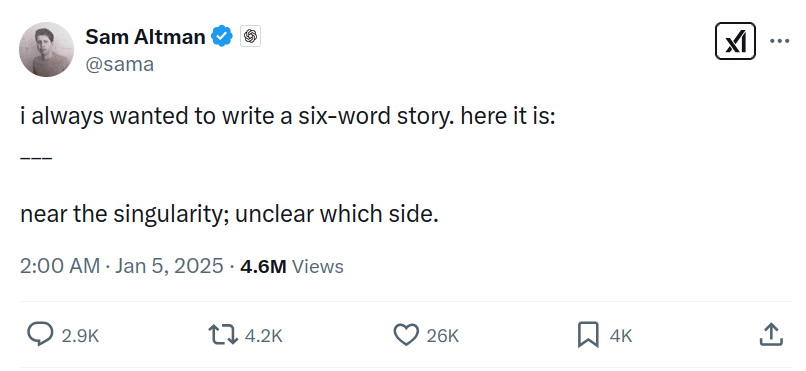
I always wanted to write a six-word story. Here it is: near the singularity; unclear which side.
It can be hard to “feel the AGI” until you see an AI surpass top humans in a domain you care deeply about. Competitive coders will feel it within a couple years. Paul is early but I think writers will feel it too. Everyone will have their Lee Sedol moment at a different time.
@Paul Schrader: I just sent ChatGPT a script I’d written some years ago and asked for improvements. In five seconds it responded with notes as good or better than i’ve ever received from a film executive.
@Paul Schrader: I’ve just come to realize Al is smarter than I am. Has better ideas, has more efficient ways to execute them. This is an existential moment, akin to what Kasparov felt in 1997 when he realized Deep Blue was going to beat him at chess.What. brought you to thisconclusion, Paul Schrader?
I asked it for Paul Schrader script ideas. It had better ones than mine.
Today, we at OpenAI launched Deep Researcher and I wanted to share a deeply personal story about how amazing this tool is and how it will change the world. Trigger warning, related to cancer….
At the end of October, my wife was diagnosed with bilateral breast cancer. Overnight, our world turned upside down. She had a double mastectomy in early December and started chemo later in the month. She’s a badass and has faced every step with unbelievable courage. Our recent challenge was whether she should do radiation after chemo. For her specific case, it’s completely in a gray area. Even the specialists we consulted gave mixed opinions—no definitive answer. We felt stuck.
Because I had preview access to ChatGPT’s new Deep Researcher feature, I decided to give it a shot. We uploaded her surgical pathology report and asked for guidance on whether radiation would be beneficial. What happened next was mind-blowing. It didn’t just confirm what our oncologists mentioned — it went deeper. It cited studies I’d never heard of and adapted when we added details like her age and genetic factors. We fact-checked each study. They were spot on.
Here’s the exact prompt I used (verbatim): “Read the surgical pathology report (attached) containing information about the bilateral breast cancer. Then research whether radiation would be indicated for this patient after 6 rounds of TCHP chemotherapy…”
“…based on the type of breast cancer. I want to understand the pros and cons of radiation for this patient, how likely it would be to reduce chances of recurrence, and whether the benefits outweigh the potential long-term risks.”I am still in awe of the report Deep Researcher gave us. We’re seeing another specialist soon, but we already feel more confident about our decision. This wasn’t just a tech demo — it was personal. It gave us peace of mind when we needed it most. We often talk internally at OpenAI about the moments when you “feel the AGI,” and this was one of them. This thing is going to change the world.
@ngxson This PR provides a big jump in speed for WASM by leveraging SIMD instructions for
qX_K_q8_KandqX_0_q8_0dot product functions. Surprisingly, 99% of the code in this PR is written by DeekSeek-R1. The only thing I do is to develop tests and write prompts (with some trials and errors)
This blew up way more than expected. Make sure to follow @ngxson’s work - he is doing a lot of great stuff for llama.cpp.